


Downfall of FTX: Havoc in crypto industry
- The Spectator

- Jul 22, 2022
- 5 min read
On November 11, 2022, the world's third largest centralized cryptocurrency exchange, once a darling of the crypto world – FTX exchange, filed for bankruptcy.
"Never in my career have I seen such a complete failure of corporate controls and such a complete absence of trustworthy financial information as occurred here," said Ray, who has decades of experience guiding companies — including Enron — through bankruptcy, when commenting on the shocking news (CBS news, 2022). The founder of FTX, Sam Bankman-Fried, saw, in less than a week, his $32-billion-worth crypto empire plunge to ashes.
What Happened to FTX?
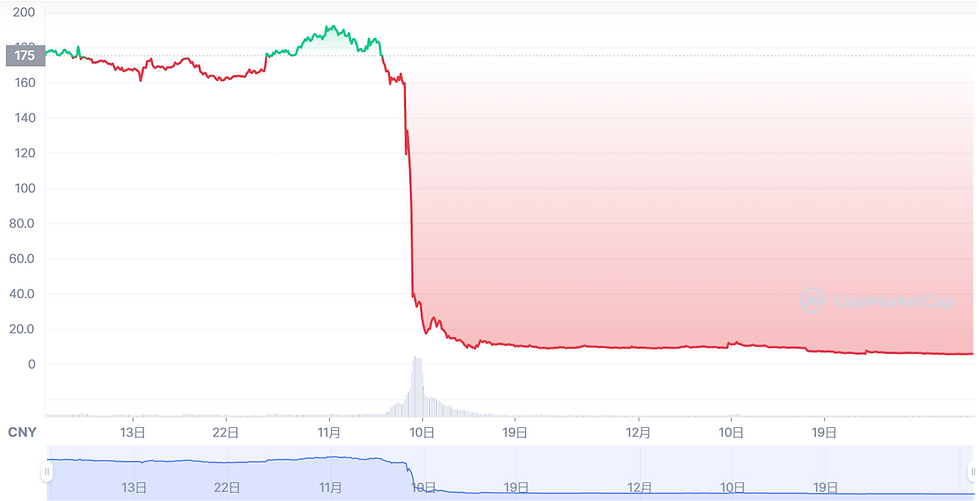
The root of the downfall lies in FTX's relationship with a quant trading company, which Mr.Bankman-Fried also owned, Alameda Research. The catalyst to all the trouble was a report by CoinDesk that revealed that Alameda Research held a position worth $5 billion in FTT, the native token of FTX. Instead of a fiat currency or other cryptocurrency usually adopted for such investments, Alameda Research based its funds upon FTT, the token that its sister company has invented. This leads to widespread concerns in the finance industry, questioning the financial stability of Sam Bankman-Fried's crypto empire and the possibility of a liquidity crunch (Reiff, N., 2022).

Despite Bankman-Fried's attempts to reassure FTX investors that its assets were stable, the customers still demanded a withdrawal worth $6 billion, fearing they would not receive their money back. In the following two days, the value of FTT fell by over 80%. In an inability to cover the liquidity gap, the company searched for additional money from venture capitalists before seeking help from its rival in the industry – Binance, on Nov.8. On the same day, Binance announced that it would purchase FTX for an undisclosed sum.
The promise, however, was short-lived.
A day later, the exchange backed out from the deal, declaring concerns over "mishandled usage of customer's funds," among other issues. On the same day, Bankman-Fried apologized on Twitter, admitting the liquidity crisis and the insufficiency in responding to the customer's demands. On Nov.11, Bankman-Fried, this businessman once compared to titans in the finance industry – like John Pierpont Morgan and Warren Buffett, stepped down as CEO, marking an end to the crypto giant FTX.
The vanished money
Why did Binance back out of the deal? Where, also, did all the customer funds go?
The truth was to be revealed in an interview in which Ms.Ellison, the administrator of Alameda Research, confessed to the public with her voice trembling. In recent months, Alameda decided to take out loans and input them into venture capital investments. Unfortunately, when the lenders demanded their money back following a crash in the crypto economy in 2022 spring, Alameda, not being able to retrieve their funds in the short period, resolved to pay withdrawals from the FTX customer funds (Yaffe-Bellany, D., 2022). On top of reports like the previously mentioned CoinDesk flying in the media questioning the financial stability of FTX, Binance's founder Mr. Zhao also declared that he would be selling his large portion of FTT tokens. The news spooked the customers, who demanded withdrawals from the exchange, leading to a liquidity crunch and the collapse in FTX's finance.
Investors' Response
As things settled, economists may safely comment that betting customers' money on venture capital investments is entirely irresponsible, and the whole act is no different from a blind gamble. Though appropriate, blaming the company does not bring back investors' money.
In interviews, most investors reflected that they "never could have seen this coming." In fact, FTX used to be considered one of the safest places in crypto where money can be stored, with such a "high-profile" and "reputable" owner – Bankman-Fried. The absurdity that this collapse comes from such a beloved figure in the industry is just another blow to the investor's confidence in cryptocurrency.
For the more than 100 million unsecured creditors of FTX (Browne, R., 2022), it will be a long, uphill battle to recover their assets, having to wait in line to get their money back while not knowing if that queue will ever end. On top of their dilemma, there is little to none protection offered, as the foundation of FTX is based off-shore in the Bahamas, escaping from the U.S. regulations.
Faced with dim prospects of regaining their assets, many individual creditors reflect, besides frustrated emotions, the mounting wariness regarding the crypto market. A Canadian YouTuber educating people on Bitcoins lost a year's worth of his salary and confessed this concern about people losing faith in the industry. Especially for him, this is just another blow since he had already lost money in 2019 during the collapse of the Canadian exchange QuadrigaCX. This repeated downfall in these seemingly powerful companies accumulates people's distrust of crypto. (WSJ What's news, 2022)
This distrust, therefore, draws forth the even more significant and imperative ramification of FTX's collapse – its influence on the cryptocurrency trade.
Impacts on the crypto industry
Even before the crash of FTX, the crypto market was already in turmoil – Bitcoin going from $69,000 to around $18-20 thousand being a good example. Contrary to common sense, such an awful situation in the market not only carries damage but also brings chances and opportunities.
With the market swirling in confusion, the collapse of FTX adds fuel to the huge volatility in the market. Throughout the day, prices of Bitcoin and other tokens jump up and down, allowing traders to obtain immense profits with small capital. "With traders using free crypto trading apps such as Bitcoineer, these traders are looking at the market and trading according to the trend of the day. If traders see that everything is down, most traders use short positions, while if they see that big tokens are showing greens, they open long positions to gain profits", said Konstantin Rabin, the Head of Marketing at Kontomatik (Konstantin Rabin, 2022).
Investors are not as lucky.
While more than 100 million lenders are left wondering if they will ever see their money again, the even more detrimental consequence lies in the shattered confidence of many investors in the whole crypto industry. Witnessing the second-dominant company falling to ashes in a matter of hours inspires a question – what prevents all the other exchanges from following the same devastating path?
It all goes down to reputation – whether or not investors can trust their money to the exchange. However, this reputation has been continuously challenged in recent years, from Bitcoin crashes to bankruptcy in exchanges, undermining investors' overall confidence in the industry with every crisis.
Future of crypto
Since the first release of Bitcoin in 2009, the world has seen balloons in its value, gaining widespread popularity worldwide. Nevertheless, as the industry developed, some notoriety also accompanied – mainly due to its instability. As the IMF puts it, "crypto assets are merely codes that are stored and accessed electronically. They may or may not be backed by physical or financial collateral. Their value may or may not be stabilized by being pegged to the value of fiat currencies or other prices or items of value" (Aditya Narain, 2022).
This contagion of distrust in crypto that FTX's crash has thrown over the industry raises the voice for further regulation. Apart from government regulation, nothing at this stage could provide crypto the stable framework it needs to run more efficiently and transparently. If the coordination of these companies were visible to the public's naked eye, FTX would never have the chance of shifting its customer funds to bail out Alameda Research, nor would the 100 million investors ever been stuck in this unprotected circumstance not knowing whom to go to for their money.
Protection for creditors and regulation of crypto exchanges must be reinforced to reassure investors that cryptocurrency is a safe place to put their money. Only with that would crypto be able to shake off the confidence crisis that FTX has thrown on the industry and flourish as it had before.


Comments